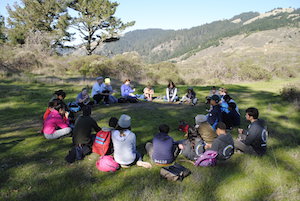
The story of a group of sixth graders learning to bridge political divides after the U.S. election.
I teach at the Millennium School, a new independent middle school located in the heart of San Francisco. Mindfulness and compassion are essential parts of our curriculum.
Yet on November 9th—the day after
the presidential election—the sixth-grade classroom I walked into was
anything but calm or kind.
What I noticed that morning was
more troubling than understandable shock, anger, or confusion. In chorus
with half the nation, our students voiced sentiments that had been
reverberating across the U.S. for months, albeit from different
political vantage points. In their attempts to make sense of the
election, I heard enmity, callousness, even what struck me as the blithe
onset of not-quite-innocent hatred.
Taking this in, I felt immense
sadness. The room appeared to be a splintered microcosm of the country
as a whole. In progressive circles, it is common to decry the hatred,
bigotry, and intolerance underlying much of Donald Trump’s rhetoric.
Here was the opposite side of that same coin.
Evidently, political divisiveness
fuels dehumanizing portraits of distant others regardless of ideology.
At that time, it had become passingly acceptable to hope for the death
of the president-elect, or to write off one’s fellow citizens as
sub-human. How else would sixth graders feel comfortable expressing
these sentiments in a progressive school in one of America’s most
progressive cities?
Following an impulse to
improvise, I Googled the electoral map and put the image up for students
to see. “What do you notice here?” I asked in a near panic. “Does
anyone know any Trump supporters?”
A few students said yes.
Guardedly at first, they began to discuss some of the reasons people
might have voted for Trump. We talked about the differences between Red
and Blue states, and why the electoral map looked the way it did.
“This is an alternative to
blaming and being afraid,” I said, more didactically than I might have.
“You don’t have to agree with someone to try to understand them.” They
knew this intuitively. It just took some work to get there.
That very afternoon over lunch, I
met with my co-teacher, Stephen Lessard, to chart a new course for the
students. At the Millennium School, students engage in interdisciplinary
Quests that center on broad, debatable questions. Each four- to
seven-week term includes two simultaneous Quests, which we distinguish
as Humanities and STEM.
Up until Election Day, students
in Humanities had been asking “Do Our Voices Matter?” Throughout the
fall, I was consistently impressed by their ability to examine complex
political questions from multiple points of view. Regular mindfulness
practice clearly helped hone their academic skills.
But on that day, it was clear to us that we needed a new Quest. It centered on a simple question: “Can I Get to Empathy?”
Stephen and I began with the
intention to enhance our students’ awareness of the difficulty of
relating to others who are different from ourselves. What we witnessed
over the next several weeks was a transformation that may yet be
possible in the world beyond our classroom.
A quest toward empathy

Feeling an obligation to define
our terms, we asked students to first distinguish empathy from sympathy.
Empathy (“feeling into”), they decided, is like putting yourself in
someone else’s shoes, while sympathy (“feeling with”) means feeling bad
for them. The distinction is not perfect, but the working definition
allowed us to begin investigating our empathic capacities and the
barriers that stand in the way.
According to the GGSC,
“Emotion researchers generally define empathy as the ability to sense
other people’s emotions, coupled with the ability to imagine what
someone else might be thinking or feeling.”
The former, known as affective
empathy, is more controversial than the latter, known as cognitive
empathy. The psychologist and cognitive scientist Paul Bloom has argued recently that
an excess of affective empathy can lead to what he calls “empathetic
distress,” where rational deliberation and sound decision-making are
impaired by too much feeling of other people’s emotions.
What this critique misses,
however, are the important ways in which both kinds of empathy can be
balanced to widen our perspectives of diverse others. As Arlie
Hochschild writes in her new book, Strangers in Their Own Land: Anger and Mourning on the American Right,
the disciplined practice of listening and feeling into others’
experience does not cede ground on moral and ethical principles.
Instead, it contributes to understanding the “deep stories” at the root
of all experience in our shared world, enabling deeper conversation,
engagement, and, ultimately, solidarity.
The value of this approach was self-evident as Millennium sixth graders watched clips of the movie Ruby Bridges.
The film tells the story of the first African-American first grader to
join a white elementary school in 1960 New Orleans. As students
inhabited multiple points of view within this complex social context,
they saw more clearly why different characters on both sides of the
integration debate felt and argued the way they did.
With a handout, we analyzed
diverse characters’ feelings and motives, the obstacles they faced, and
the strategies they used for overcoming them. We discussed some of the
moral and political issues behind school integration in the American
South—and we focused on the role of feelings apart from political context.
With the sound turned off (this
was Stephen’s brilliant idea), we reviewed several key segments of the
film to analyze emotions in facial expressions. Early on, Ruby’s mother
looks terrified as she sees a news clip of white protestors opposing
integration on television. Later, a white mother’s anger is revealed as
subtly similar in its underlying fear and anguish.
Our sixth graders got it.
Regardless of their beliefs or roles in the social conflict, these were
all human beings. Getting to empathy allowed us to understand where each
character was coming from, which lent a fuller appreciation of the
complexity they were facing. This did not absolve the injustice of
segregation. It clarified the deep stories underlying it.
A more profound reckoning may
have come when we examined a more current political conflict. Just
before the election, CNN’s Van Jones traveled to Gettsyburg,
Pennsylvania, a historic site of American division, to talk to several
groups of voters. The resulting conversations, uploaded as episodes 1-3 of “The Messy Truth,” offer a warning to a nation beset by bitterness, mistrust, and hostility.
“I’m worried,” Jones says as he
introduces himself to a living room full of Trump supporters. “So are
we,” a voice responds. This underlying symmetry points to an
oft-overlooked agreement between the two sides in the so-called culture
war. Yet without a willingness to listen and understand the other, there
is no chance for them to hear and heal.
At first, Millennium students
were reactive and judgmental as they watched Trump supporters explain
themselves. Several called out at the screen to loudly voice their
disagreement. As we repeated the same experiment of analyzing face work,
however, the timbre of their engagement changed.
The key scene we analyzed—first
with sound, then without—shows a woman break down as she relays her
experience of being attacked by a close friend on social media for her
political views. “It broke my heart,” she says through tears.
As we watched without volume, her
pain is undeniable. This time students responded with care, compassion,
and more nuanced understanding. They got to empathy by listening more
deeply. Upon reflection, many saw that what stood in the way initially
was their own self-righteousness.


No comments:
Post a Comment