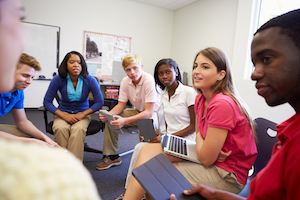
Students are talking about race and racism. Social-emotional skills can help keep those discussions civil and empathic.
This isn’t your average school year. There are politicians and media personalities who are fanning the flames of racial hatred,
their words seeping out to kids through the news. Educators are
grappling with the aftermath of Charlottesville, and we have
undocumented students who feel threatened by anti-immigrant policies
coming from state capitols and Washington, D.C.
Students have questions and concerns, and they want to discuss these issues. But what role can educators play in modeling civil discourse without allowing their own blind spots and biases to get in the way? Tricky business, especially for those who live in very white parts of the country. “White folk initiating conversations on race…the road to nowhere,” said one teacher of color. “Go get connected with a marginalized group and listen.”I asked teachers on Facebook, “What sorts of conversations around race have you been witnessing (or facilitating) at school this fall?” One Washington state high school teacher described starting a group for women of color, where “the girls were able to speak freely about any issue they wanted to discuss.” Another educator led discussions about the “taking a knee” protests in the NFL. In some social studies classes, said the teachers, they talk about race every day, in many ways. “We have also been discussing the diversity of Native American communities across the country and have several students with different tribal connections,” said one.
Indeed, these are inherently difficult, complex discussions, but schools with social and emotional learning (SEL) programs might have an advantage in tackling them.
SEL centers on the key attitudes
and skills necessary for understanding and managing emotions, listening,
feeling and showing empathy for others, and making thoughtful,
responsible decisions. It’s not hard to see how SEL skills might be
helpful in difficult discussions. Here are three you can apply to
conversations about race and racism with students, staff, and community
members.
Self-awareness: Acknowledging implicit bias
We each walk into our schools
with stories, histories, and experiences that inform our perspectives.
Accurate self-perception may be challenging to achieve, yet there are
tools and resources that can prompt us to regularly engage in active
self-exploration.
Self-awareness is a foundational
component of social and emotional learning—one that begins with
questions you ask yourself. What are the stories you tell yourself (or others) about your students—and how do you tell them? Do you help your students feel powerful at school and celebrate their strengths? In what ways? Through questions like these, you can try to consciously unearth your own implicit biases, values, and beliefs.
Mindfulness can help—that is, the
practice of cultivating nonjudgmental, moment-to-moment awareness of
thoughts and feelings. Mindfulness requires time and commitment, but research suggests that mindfulness may reduce implicit age and race bias.
As most of us know from simple,
everyday experience, none of us is actually blind to race or color. When
we raise awareness of our emotions and sensations in a given moment
through mindfulness, we are more likely to be able to regulate emotional
responses, reduce anxiety, and increase empathy and perspective-taking.
All of these conditions can potentially support us in minimizing bias.
In light of your biases, consider
how comfortable you are talking about race or racism in the classroom.
Whatever your level of comfort or discomfort, these simple sentence
stems from Teaching Tolerance may prompt you to reflect:
- The hard part of talking about race/racism is…
- The beneficial part of talking about race/racism is…
In addition, this self-assessment tool from
Teaching Tolerance may help you to identify your vulnerabilities,
strengths, and needs in order to more thoughtfully prepare yourself for
facilitating discussions about race with your students.
Your students can also help you to cultivate self-awareness.
Although I have facilitated many
conversations about race and racism in high school and college
classrooms over the years, I still get a little anxious every time I
lead such discussions, largely because of my own whiteness and
privilege, so I simply name and acknowledge my position (and my sense of
vulnerability) with my students.
I also invite them to let me know
when I say something that they perceive as insensitive or offensive.
It’s a good way to begin a difficult conversation—and hopefully gives
students permission to take emotional risks, as well.
As a result, students approach
me, both privately and publicly, to kindly offer suggestions for
adjusting my instruction (e.g., incorporating new readings or panel
discussions with students of color). I believe students have also found
my office to be a safe space to share their experiences of racism. The
more I ask, the more I learn.
Self-management: Navigating strong emotions
From self-awareness, we gain the
ability to manage the interaction of our own feelings and behavior,
which raises a new set of questions. What are the triggers that cause
your intentions and actions to diverge? Can you keep your calm when
certain topics pop up in the classroom? How might you navigate your own
emotions in a fueled conversation with students or staff?
If you haven’t already, map out a
series of steps you might take when you are feeling particularly angry
during a discussion, and consider sharing your “self-management” steps
with your students during a simple think-aloud.
For example, when I find myself upset during a challenging interaction, I frequently do the following:
- Notice my body’s reaction (e.g., heat rising in my body, a sense of my throat closing)
- Pause briefly
- Feel my feet on the ground
- Take a deep breath, in and out
- Stroll around the classroom, if possible, to burn off energy, and then…
- Decide how to respond.
If students see you openly
modeling your own self-management practices, they may feel more
motivated to individualize their own set of steps for cooling down.
As an additional model of self-management in action, this video of a Canadian politician’s response to hateful anti-Muslim comments may be worth sharing with your colleagues and students.
Jagmeet Singh’s ability to remain
calm while focusing himself and his audience on “love and courage” is
inspirational. You might lead students in a brief discussion of the
principles and strategies he may have used to respond to a woman’s angry
accusations with grace and composure.
Finally, this tool from
Teaching Tolerance may also help you to foster a stronger sense of
safety in your classroom when conversations become emotional. It
features strategies to use when emotions like anger, blame, guilt, or
denial are present during a discussion of race or racism.
For example, when you experience
pain or anger in the classroom, you can check in with your students and
model the tone of voice you expect everyone to use. When you sense
confusion or denial of racism, “You can ask questions anchored in class
content or introduce accurate and objective facts for consideration.”
Social awareness: Cultivating a reflective classroom community
Classrooms must be safe spaces
where students’ perspectives can be heard. It’s our job as teachers to
create an environment where students can become more attuned and
socially aware citizens.
Facing History and Ourselves, a
non-profit organization, provides educational materials for encouraging
middle school and high school students to engage in civil discourse. They suggest the following general principles for creating reflective and supportive classroom community:
- Create a sense of trust and openness
- Encourage participants to speak and listen to each other
- Make space and time for silent reflection
- Offer multiple avenues for participation and learning
- Help students appreciate the points of view, talents, and contributions of less vocal members
If you are planning to lead a
discussion around a sensitive or controversial topic, the following
three teaching strategies may also be useful in both encouraging diverse
viewpoints and highlighting active listening as a foundational
relationship skill.
- Big Paper: Building a Silent Conversation: Students silently respond to a quote, image, or document excerpt. In groups of two or three, they add comments and questions to create a rich written discussion.
- Barometer: Taking a Stand on Controversial Issues: Participants place themselves on a continuum based on their position on an issue, reflecting a broad range of perspectives.
- Save the Last Word for Me: Small groups of students follow a specific discussion pattern to debrief a reading or a film.
Whether you are using a
particular teaching strategy or simply holding a classroom meeting, it’s
crucial to create a physical space where you and your students can see
and respond to one another. The Open Circle Curriculum features
a discussion structure where students form a circle of chairs,
including an empty seat to symbolize that there is always room for
another person, voice, or opinion.
By paying attention to the skills
of self-awareness, self-management, and social awareness in our
classrooms, we are more likely to cultivate environments where students
can actively practice relationship skills and responsible
decision-making—the fundamental elements and outcomes of civil
discourse.


No comments:
Post a Comment